2:58 PM
 antimicrobial

Spreadin' the glove: TSA infecting U.S.?
Latex coverings 'have been in crotches, armpits, touching people who may be ill'
By Bob Unruh
© 2011 WorldNetDaily

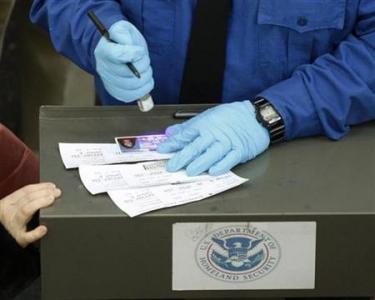
That's the word being discussed on dozens of online forums and postings after it was noted that the agents wear the same gloves to pat down dozens, perhaps hundreds, of passengers, not changing them even though the Centers for Disease Control in its online writings has emphasized the important of clean hands to prevent the exchange of loathsome afflictions.
"Herpes via latex glove ... ewwww," wrote one participant on the independence-minded AR15 website forum.
Responding to the question, "Does the TSA change latex gloves after each sexual assault?" another wrote on the same forum, "I seriously doubt it. Gloves are for their protection, not yours."
In fact, TSA officials in both national and regional offices declined to respond to WND inquiries about the policy for changing gloves to prevent an infection that may be on the clothes or body of one passenger during a pat-down by TSA agents from being transmitted to other passengers, including children, in line.
Martha Donahue in a commentary at Resistnet said she'd spent 30 years in the medical industry. "For those of you who fly and opt for the 'pat down,' you need to demand the TSA thugs change their gloves. I've been watching on the news how they operate. People are being searched [with] dirty gloves ... gloves that have been in crotches, armpits, touching people who may be ill, people who pick their noses. Do you want those gloves touching you?
"These thugs are protecting themselves from you. You need to be protected from them," she wrote. "In a hospital, nursing home, in-home care, or even labs, that would never even be considered an option."
ABC reported one of its news employees documented how a TSA worker reached inside her underwear.
"The woman who checked me reached her hands inside my underwear and felt her way around," the ABC employee said in the network's report. "It was basically worse than going to the gynecologist. It was embarrassing. It was demeaning. It was inappropriate."
Asked today about the possibility of contamination being spread from one passenger to another on the gloves of TSA agents, a spokesman for the CDC bailed.
"Please contact the Dept of Homeland Security and/or TSA on this issue," the spokesman told WND.
But in its online writings, the CDC repeatedly makes clear the importance of maintaining clean hands to avoid such transmission of communicable and contagious afflictions.
Dr. Julie Gerberding, at the time the chief of the CDC, said during a special presentation on hand cleanliness, "We know that hand hygiene is a critical component of safe and healthy health care."
At the same time, Dr. John Boyce, lead author of the organization's hand-washing guidelines and the chairman of the Hand Hygiene Task Force, said, "There's a large study that was conducted at the University of Geneva Hospital in Switzerland where they demonstrated significant improvement in the adherence of health care workers to hand hygiene practices and they also showed that the incidence of antibiotic resistance to staph infections went down and that the overall prevalence of health care-acquired infections went down ... ."
Suggested Gerberding in the context of health care, "Hand hygiene saves lives. We're recommending a comprehensive evidence-based approach in hospitals that consists of handwashing with soap and water when the goal is to remove unsightly debris; hand alcohol preps for enhancing appearance and reducing bacterial counts; and gloving when people have contact with blood or other body fluids in accordance with universal precautions."
She said even in a "community setting," "washing with soap and water remains a very sensible strategy for hand hygiene."
Other health standards across the country routinely warn against hand contact with sores, lesions or other sources of viruses or contamination. The Lincoln, Neb., health site notes, "This includes hand contact."
Officials at the Canadian Center for Occupational Health noted that "hand washing is the single most effective way to prevent the spread of infections.
"You can spread certain 'germs' (a general term for microbes like viruses and bacteria) casually by touching another person. You can also catch germs when you touch contaminated objects or surfaces and then you touch your face (mouth, eyes, and nose)," it said.
In a forum on The Hill,writer Carol Felsenthal said agents should, simply in the course of their work, change gloves between passengers.
"Anyone who has visited a fast food joint, a doctor's office or a hospital has watched as workers change gloves between servings or exams. And if they don't, the customer/patient would surely say something," she wrote. "How often do the TSA agents doing the 'enhanced pat-downs' change gloves?"
She wrote that she was wondering "about the possibility of screeners passing everything from bedbugs to skin infections from one passenger to another."
She continued, "Latex glove issues might seem minor, but there ought to be procedures to require TSA screeners to don fresh gloves each time they encounter a new passenger."
On a TSA blog promoting the agency's actions and policies,one screener explained, "Changing gloves is fairly simple ... . When I gate screen I carry about 10-12 pairs in my pockets."
Respondents to the comment were outraged, "That's just plain disgusting and most certainly not acceptable ... procedures as set forth by the CDC for usage of gloves for protection," said one. "Reasoning being is that the bacteria count in your pockets is about the same is your mouth or armpit."
Wrote another forum participant, "Those gloves are soiled if they come out of your pockets and before handling my stuff you will be expected to obtain a clean, from the original container, pair.
... Who knows what filth inhabits your pockets!"
Officials at the city-owned Denver International Airport, some 20 miles northeast of downtown, said they had no participation in making any health policy regarding the gloves used by TSA screeners on Denver passengers, and, in fact, did not know if there was a policy.
On the Above Top Secret blog, the author was trying to provide a public service.
"Those gloves are worn for the protection of the agent," wrote the commentator. "You must request that they change the gloves in your presence or you risk acquiring venereal disease resulting from a fondle/molest search."
http://www.wnd.com/index.php?pageId=231733
 Posted in: